The attack that concerns me most isn’t the one that breaches your strongest defences.
It’s the one that slips through the space between them. ⚠️
A family I worked with last year had implemented textbook physical security measures.
🏡 Gated property,
🛂 vetted staff, and
👤 close protection for the principal when travelling.
They’d done everything right – or so they thought.
What they hadn’t anticipated was their teenage son’s girlfriend posting Instagram stories from their kitchen. 📱✨
Nothing malicious – just a seventeen-year-old sharing her weekend.
However, those stories showcased:
- 🖼️ the interior layout
- 🌳 the view from the windows that revealed the garden configuration
- 🎨 artwork that confirmed the family’s taste and wealth
- 📦 and in one case, a delivery box with a partially visible address
Three weeks later, the family received a detailed letter at their home.
The sender knew:
- the room layouts
- the son’s name
- which school he attended
- that a girlfriend existed
The letter wasn’t overtly threatening – it was worse. It demonstrated capability.
It said: I know everything about you, and your expensive security didn’t stop me from learning it.
The family’s physical security had never been tested because it didn’t need to be.
The threat had gathered everything it needed without going anywhere near their gates. 🚪
🔧 The Space Between
After three decades in this work, I’ve learned that sophisticated threats rarely attack head-on.
They find the seams – the places where one type of protection ends and another should begin, but doesn’t. ⚡
Consider how threats develop:
Someone becomes fixated on a prominent individual.
They research online:
- 🏠 finding addresses through property records
- 📲 mapping routines through social media
- 🗂️ identifying vulnerabilities through business filings
By the time they appear physically, they’ve conducted weeks of digital reconnaissance.
Yet most security programmes treat these as entirely separate problems.
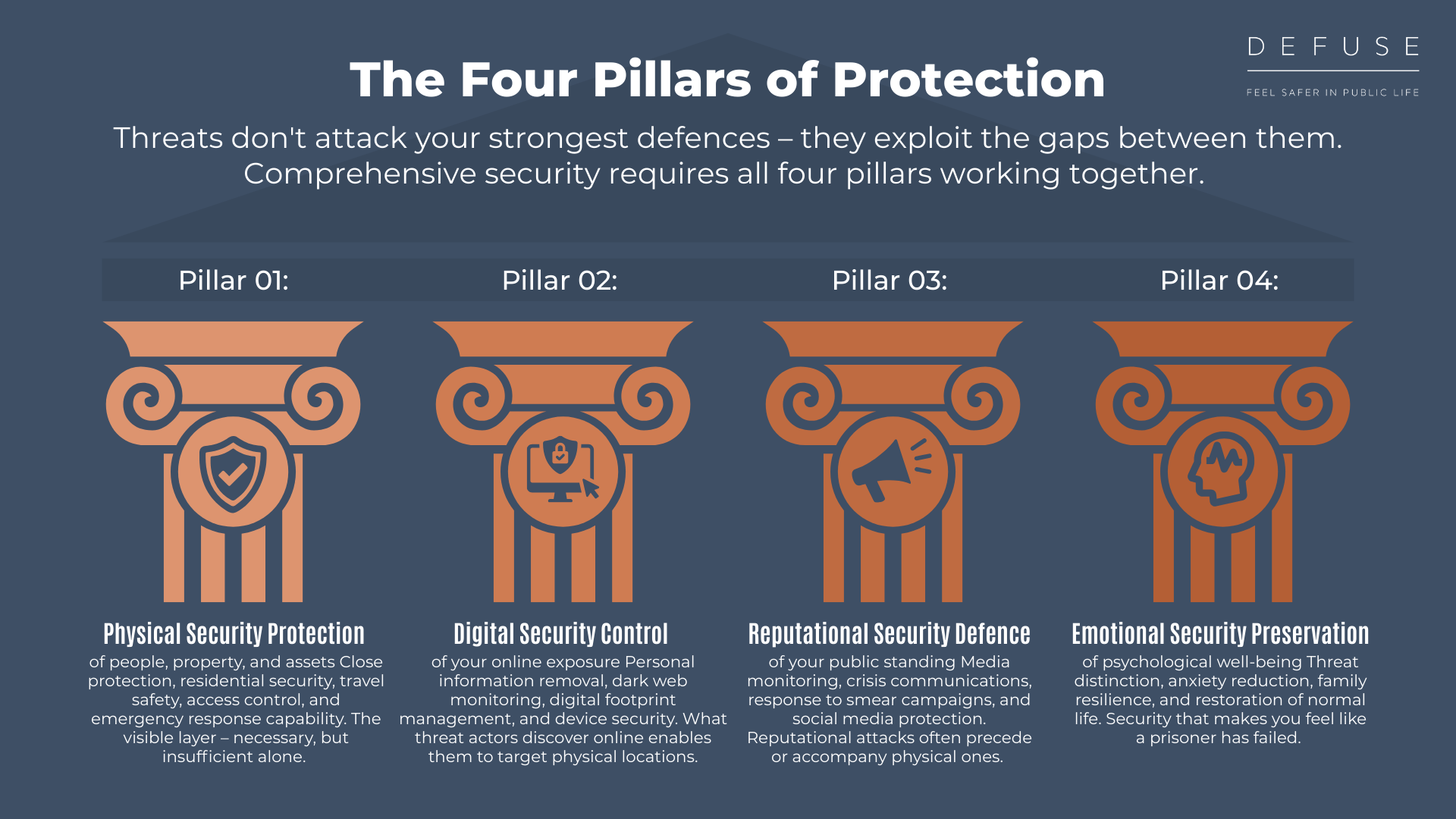
This is why I work with a framework of four interconnected pillars:
🔹 Physical
🔹 Digital
🔹 Reputational
🔹 Emotional
Not because each one matters independently – that’s obvious – but because the gaps between them are where threats find opportunity.
🧩 Where the Seams Show
1️⃣ Physical ↔ Digital
The gap between physical and digital security is the most exploited.
- Families invest substantially in residential protection
- …whilst their home addresses remain visible on data broker sites
- Close protection teams accompany principals
- …but meeting locations are shared days in advance on unsecured calendar apps
2️⃣ Digital ↔ Reputational
A hostile actor may never physically reach you.
They can still weaponise information to:
- shape media stories
- drive online pressure campaigns
- undermine business interests
3️⃣ Reputational ↔ Emotional
This is subtler — but just as damaging.
A public attack, even baseless, chips away at a family’s psychological resilience.
Families unprepared for a reputational crisis often:
- freeze
- second-guess themselves
- make poor decisions under stress
The threat actor doesn’t need to ruin the reputation — only the family’s peace of mind. 🧠💥
4️⃣ Emotional ↔ Physical
This completes the circle.
Family members suffering from chronic anxiety:
- default to predictable routines
- miss warning signs
- reject sensible precautions simply to regain a sense of normality
🔒 Closing the Gaps
When we assess a family’s security posture, we’re not primarily examining the strength of individual measures.
We’re looking for the spaces between them.
Ask yourself:
- Where does your physical security end and your digital exposure begin?
- What happens to your family’s well-being when your reputation comes under attack?
- How does chronic anxiety affect your ability to implement sensible precautions?
Threats are opportunistic.
They flow around your strongest defences toward your weakest points – and those weak points are almost always found in the gaps.
The families who sleep soundly aren’t necessarily those with the biggest budgets.
They’re the ones who understand how their measures connect – and who’ve closed the seams. 🧵
🛡️ Finding Your Gaps
At Defuse Global, we assess security across all four pillars – but more importantly, how they connect.
Our services include:
🔍 Personal Digital Exposure Assessment
Reveals what information is already available to those who might wish you harm.
🧠 Behavioural threat assessment methodology
Developed from US Secret Service research, identifying how threat actors gather intelligence and plan approaches.
🤝 Retained advisory relationships
Ensuring that as your circumstances change, your protection evolves accordingly.
Most families discover their gaps only after something falls through them.
The more innovative approach is finding those seams before a threat actor does. 🚫🎯
📞 Request a confidential consultation
Let’s assess where your security measures connect – and where they don’t.