Research & Insight
Understanding grievances, fixation and the risk of violence
Most of us have felt badly treated at some point. Perhaps we were dismissed from a job, rejected by a partner or involved in a dispute that left us feeling angry or humiliated.
We may complain, seek advice or spend time thinking about what happened. Eventually, most people find a way forward. But some struggle to let go.
They become preoccupied with what they believe has happened to them. They repeatedly revisit the injustice, blame another person or organisation and may begin pursuing those they hold responsible.
For anyone on the receiving end, the difficulty is knowing what that behaviour means. Is the person angry and seeking an explanation? Will the unwanted contact continue? Is there evidence that they may cause harm?
Two studies published in 2026 by threat assessment researchers Adam C. Cotton and Mario J. Scalora help us understand these differences.
What the research examined
Adults in the first study, examining the seriousness of reported behaviour.
Adults in the second study, examining repeated and varied behaviour.
Both studies relied on participants describing their own experiences and actions. They identify associations; they do not prove what causes violence.
01What is a grievance?
A grievance is a belief that someone has suffered a wrong or injustice. It might involve a relationship breakdown, dismissal, financial dispute, perceived discrimination or rejection.
The grievance may be based on something that genuinely happened, a misunderstanding or an interpretation that other people do not share. Having a grievance is normal. People have every right to complain, challenge decisions and seek remedies.
The concern arises when the grievance becomes central to someone’s thinking and begins to drive unwanted or harmful behaviour towards another person.
The distinction that matters
The researchers found that the type of grievance generally offered limited help in distinguishing people who reported more serious behaviour. What mattered more was how they responded to it.
02When someone becomes fixated
One of the clearest findings concerned preoccupation, sometimes described as fixation. This happens when someone becomes increasingly absorbed in a particular grievance.
What this might look like
- Repeatedly revisiting what happened.
- Returning to the same accusations.
- Spending more time discussing or posting about the grievance.
- Continuing to seek contact after a dispute appears to have ended.
The first study found that greater preoccupation was associated with more serious reported behaviour. The second found that preoccupation was also associated with more frequent and varied actions.
Thinking repeatedly about something upsetting is common and does not establish that someone is dangerous. It becomes more relevant when accompanied by concerning behaviour towards another person.
03Why persistence matters
Persistence means continuing to pursue a grievance through repeated actions. A person might send emails, telephone, post online or attempt personal contact. They may use several methods to reach the individual they blame.
Each incident may appear relatively minor when considered separately.
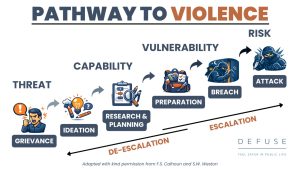
How a pattern can become apparent
Illustrative example, not a case from the studies.
- Initial complaint. An individual repeatedly contacts a former employer about a dismissal.
- Continued unwanted contact. Messages and telephone calls continue despite clear responses.
- Different forms of contact. The individual begins using other channels to pursue those they blame.
- More intrusive conduct. The individual attempts unwanted personal approaches or seeks private information.
The studies did not establish that grievances necessarily develop through these stages.
The second study found that more persistent behaviour was associated with preoccupation, support for aggressive beliefs and engagement with violence-supporting material or people.
Its measure of persistence reflected the frequency and variety of reported actions, rather than how long the behaviour continued.
04Anger does not tell the whole story
An angry message can be frightening. But the strength of someone’s language is not a reliable measure of what they may do.
The first study found associations between more serious behaviour and feelings such as anger, shame and victimisation. The second found that emotional reactions alone were less closely associated with persistent behaviour than fixation, beliefs and social influences.
What to remember
Someone who sounds furious is not necessarily more dangerous than someone who appears calm. Their beliefs, actions and changes in behaviour provide more useful evidence.
05When aggression begins to seem justified
There is a difference between being angry with someone and believing that person deserves to be harmed.
Both studies found links between beliefs supporting aggression or violence and more serious or persistent behaviour. The concern is greater when someone begins to regard harmful action as acceptable, deserved or necessary, particularly alongside repeated unwanted contact or other intrusive conduct.
An extreme opinion alone does not establish an intention to act. The wider circumstances still matter.
06The influence of other people
Friends, colleagues and online communities can help someone cope with a grievance. They can also reinforce hostility.
The researchers found that engagement with violent content or people who supported violence was associated with more serious and persistent behaviour. In the second study, this was the strongest factor associated with persistence when the measured factors were considered together.
Why the social setting matters
- Others may repeatedly confirm the person’s belief that they have been wronged.
- Some may encourage continued confrontation.
- Exposure to material supporting violence may reinforce beliefs that aggression is acceptable.
The research found associations. It did not prove that social influence caused violence or persistent behaviour.
07What the figures tell us
In the first study, 605 participants described their grievances and the most serious actions they had taken.
Most serious behaviour reported
Percentage of participants in the first study (n = 605)
These percentages describe this research sample. They are not estimates of how many people with grievances become violent in the general population.
Of the 72 participants who reported violent behaviour, 69 also reported other categories of unwanted or intrusive conduct. That does not establish which behaviour happened first. It does show that violence was often reported alongside other forms of conduct.
The second study found that people who reported greater fixation, support for aggression and engagement with violent material or associates generally reported more frequent and varied behaviour.
08What should you pay attention to?
For someone unfamiliar with threat assessment, these questions offer a practical starting point.
Questions worth asking
- Is the person becoming more preoccupied? Are they spending more time revisiting or acting on the grievance?
- Is unwanted contact continuing? Are messages, calls or approaches repeated despite being unwanted?
- Is the conduct becoming more intrusive? Are they monitoring, following, seeking private information or attempting unwanted approaches?
- Are they justifying aggression? Do they describe harmful action as deserved or acceptable?
- Are others reinforcing hostility? Is there evidence that people or online communities are encouraging aggressive responses?
These questions help structure an assessment. They are not a validated risk scoring tool.
09What should you do?
If someone is pursuing you, a family member or your organisation, begin by establishing the facts.
- Keep a record. Retain messages, dates, details of approaches and changes in behaviour.
- Describe conduct accurately. Record what the person has said and done rather than relying on labels such as obsessed or dangerous.
- Manage legitimate complaints appropriately. Consider whether there is an unresolved issue that requires a response through a clear channel.
- Seek specialist advice when warranted. Persistent, intrusive or threatening conduct may require a behavioural threat assessment. Contact the police if there is an immediate threat to safety.
- Review changes. New behaviour or information may alter the assessment and the action required.
What the research helps us understand
Cotton and Scalora’s findings reinforce the value of examining the person behind a grievance. The original complaint may explain why someone feels wronged. To understand the concern, we also need to consider their beliefs, the influence of others and what they are actually doing.
The research does not provide a way to predict who will become violent. Both studies relied on self-reported behaviour, and neither followed participants over time to establish how their conduct developed.
They do, however, provide useful evidence about why fixation, persistent behaviour and beliefs supporting aggression deserve attention.
A grievance tells us what someone believes has happened to them. Their behaviour helps us understand what they may be prepared to do about it.