Right now, in a British high-security prison, sits a man whose name has become an unlikely factor in a diplomatic dispute between Britain and Iran. Richard Jan means nothing to most people. To Craig and Lindsay Foreman, the British couple sentenced to ten years in an Iranian jail on spying charges they deny, his name may be the one thing standing between them and home. Iran wants Jan, born in London to Iranian parents, and stripped of the British passport, he gave up behind bars, and returned home on health grounds. The Foremans were arrested barely a month after the Parole Board refused him release in late 2024, and their family now believes his deportation is the only card left to play.
That is the story the papers are running. It is not the story that matters to me.
Strip away the politics, and you are left with one of the clearest cases I know of how an ordinary man, with an ordinary grievance, became what the press would later call the worst stalker this country has ever seen. Twenty years on, his case still earns its place on every threat assessment course worth attending, because the mistakes made around him are the same mistakes organisations are making this week.
A grievance is born
Wind the clock back to 1996. Jan was a biochemistry graduate working as a lab technician at Queen Charlotte’s Hospital in Hammersmith. Then came redundancy, and with it a slide into depression and a temper his family could no longer manage. Worried for him, his own parents did the responsible thing and asked Ealing Social Services to assess his mental health.
A care manager, Shauna Bailey, turned up to carry out that assessment alongside a colleague from the local mental health trust. Their finding was straightforward enough: Jan had no treatable mental illness, and there were no grounds to detain him under the Mental Health Act. For most people, that would be the end of a difficult afternoon. For Jan, it landed very differently. The people who had assessed him stopped being professionals doing their job and, in his mind, became responsible for what had gone wrong in his life.
Here is the point that matters. Bailey had done nothing wrong. She had carried out a lawful assessment and reached a defensible conclusion. None of that mattered. Once she became the face of his grievance, she became a target, and she remained one for years.
When a grudge stops being a grudge
We all carry grievances. You will have one or two of your own; so do I. The overwhelming majority of us grind our teeth, have a moan to a friend, and move on. That ordinary letting go is exactly what a fixated person cannot do.
Jan did not move on. He dug in. He lodged 211 formal complaints against the assessment team and anyone connected to them. His targeting widened to include a second NHS trust, the solicitors acting for the council, and a mental health charity. He gave his campaign a code name, Saffron Sun, and ran it like a project manager. Throughout the campaign, he made around 4,500 nuisance calls and sent around 200 threatening letters. Pizzas that his victims had never ordered turned up at their doors. So did pest controllers. By the time it reached court, the prosecution had gathered more than a thousand statements and lined up over a hundred witnesses.
Notice what was happening here, because organisations almost never do. The original complaint had long since been dealt with. The grievance sitting behind it had not. Jan was no longer chasing an outcome; he had found a purpose.
When the campaign turned violent
For a long time, the campaign was menacing rather than dangerous: the calls, the letters, the unwanted deliveries, the broken car windows, the silent phone calls. Disruptive and intimidating, but not yet a threat to life.
Then, in August 2001, he set fire to Shauna Bailey’s car outside her home. She did not work again and moved to an address she kept secret.
Three months later, he turned to Councillor Liz Brookes, who, back in 1996, had chaired the committee that heard his complaints. She woke in the night to the sound of running water in her hallway and went downstairs, believing she was being burgled. As she reached it, the glass in her front door shattered, and a fireball came up, forcing her back into the front room. Her partner escaped across the roof and was rescued by the fire brigade, and the rest of the family also got out. Their home was left uninhabitable for six months.
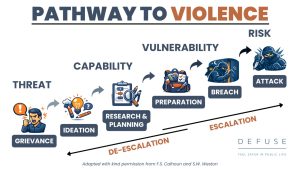
That is the road these cases travel. It is rarely quick and almost never straight, but it has a recognisable shape: a grievance that hardens into fixation, a fixation that starts demanding action, and an escalation that climbs until it tips into violence.
Why nobody stopped it
The obvious question, the one asked after every case like this, is how on earth it was allowed to run for as long as it did.
The honest answer is uncomfortable, because it has very little to do with incompetence. Every organisation Jan targeted was staring at its own small slice of him. The council saw complaints. The trust saw letters. The solicitors saw legal correspondence. The police saw separate incidents reported weeks apart. Each piece, looked at on its own, read as a nuisance rather than a danger.
Jan suffered no such confusion. He could see the entire campaign, because he was the one running it. There is the rub: the threat lived in the pattern, while every single person responding to it could only ever see the pieces. Lay those pieces side by side, and the danger is glaring. Almost nobody laid them side by side.
What the case still teaches us
Boil the Jan case down, and five plain lessons fall out of it. None of them are clever. All of them are still being missed.
1. Watch the person, not just the complaint. Closing a complaint resolves a piece of paper and nothing more. The person who raised it may have accepted the outcome, or may be quietly settling in for a long campaign. Those are wildly different situations, and only one of them stays visible once you have filed the matter as “dealt with.”
2. Persistence after a clear “no” is information. Tell most people firmly to stop, and they stop. Someone who hears your refusal and treats it as a reason to try harder has just told you something important about the way their mind works. That is not a difficult customer. That is a warning.
3. A spreading list of targets means the risk is rising. Jan began with one care manager and ended up pursuing councillors, lawyers and a charity. Once a grievance starts reaching anyone who happened to stand near the original issue, the goal has changed from fixing a problem to punishing people, and that shift in goal is among the most reliable danger signs we have.
4. Effort tells you more than threats. Angry people make threats all the time and do nothing about them. The ones to watch are the quiet ones, pouring more and more time, energy, and ingenuity into the pursuit, digging up home addresses, learning routines, growing more inventive by the month. Loud language alarms people. Sustained, methodical effort is what causes harm.
5. Someone has to join the dots. This is the lesson that matters most. For as long as each department, each agency and each organisation studies its own fragment in isolation, the only person holding the full picture is the offender. The whole has to belong to somebody on your side of the table.
The warning signs, in brief
If you take nothing else from the Jan case, take this short list. These are the behaviours that, when considered together, distinguish an awkward situation from a dangerous one.
- Vexatious or persistent complaints. Complaints made not to resolve an issue but to keep a grievance alive. The volume and the repetition tell you more than the content of any single one.
- A grievance that becomes an identity. The point at which someone stops wanting an outcome and starts needing the pursuit. The original issue fades; the campaign takes its place.
- Blame is displaced onto the messenger. The people who delivered a decision are recast as the cause of it, and become targets in their own right.
- A widening circle of targets. The pursuit spreads from the original subject to colleagues, managers, advisers, family, and anyone standing nearby.
- Escalating effort. Rising investment of time, money and ingenuity. Effort is a far more reliable signal than language.
- A move from contact to intrusion. Gathering home addresses, routines and personal details marks the shift from nuisance towards surveillance.
- An inability to accept any outcome. The complaint is answered, the appeal heard, the court has ruled, and still it goes on.
- Fragmented information. Each party holds only its own piece, and only the creator can see the whole pattern.
The real point
Jan is back in the headlines because of a prison cell in Iran and a couple trying to get home, and it is easy to see why that is the version being told. But the reason his case still sits on my shelf, two decades after the verdict, has nothing to do with diplomacy.
People very rarely leap straight from grievance to violence. There is almost always a road between the two, and there are almost always footprints on it long before anyone gets hurt. Reading those footprints early enough to act on them is the entire job. Twenty years on, Richard Jan is still teaching that lesson, and far too many organisations are still learning it the hard way.
At Defuse Global, we help prominent people, their families and their family offices recognise grievance-driven threats early and manage them before they escalate. By the time the violence arrives, the warning signs have usually been there for months. Sometimes years.